Draft Documentation
This page is currently under development. Content may be incomplete or subject to change.
Makes extensive use of AI-generated documentation.
Automated Verification#
Automated verification enables SysGit to integrate with external test systems, simulation tools, and hardware-in-the-loop (HIL) environments to automatically update verification status based on actual test execution. This transforms verification from a manual, document-centric process into an automated, model-based workflow with complete traceability.
Overview#
SysGit's approach to automated verification leverages the Python object model (sysgit-py) to:
- Read verification case definitions from SysML v2 models
- Execute or interface with test systems
- Collect test results from external sources
- Update verification verdicts programmatically
- Commit changes back to Git for full audit trail
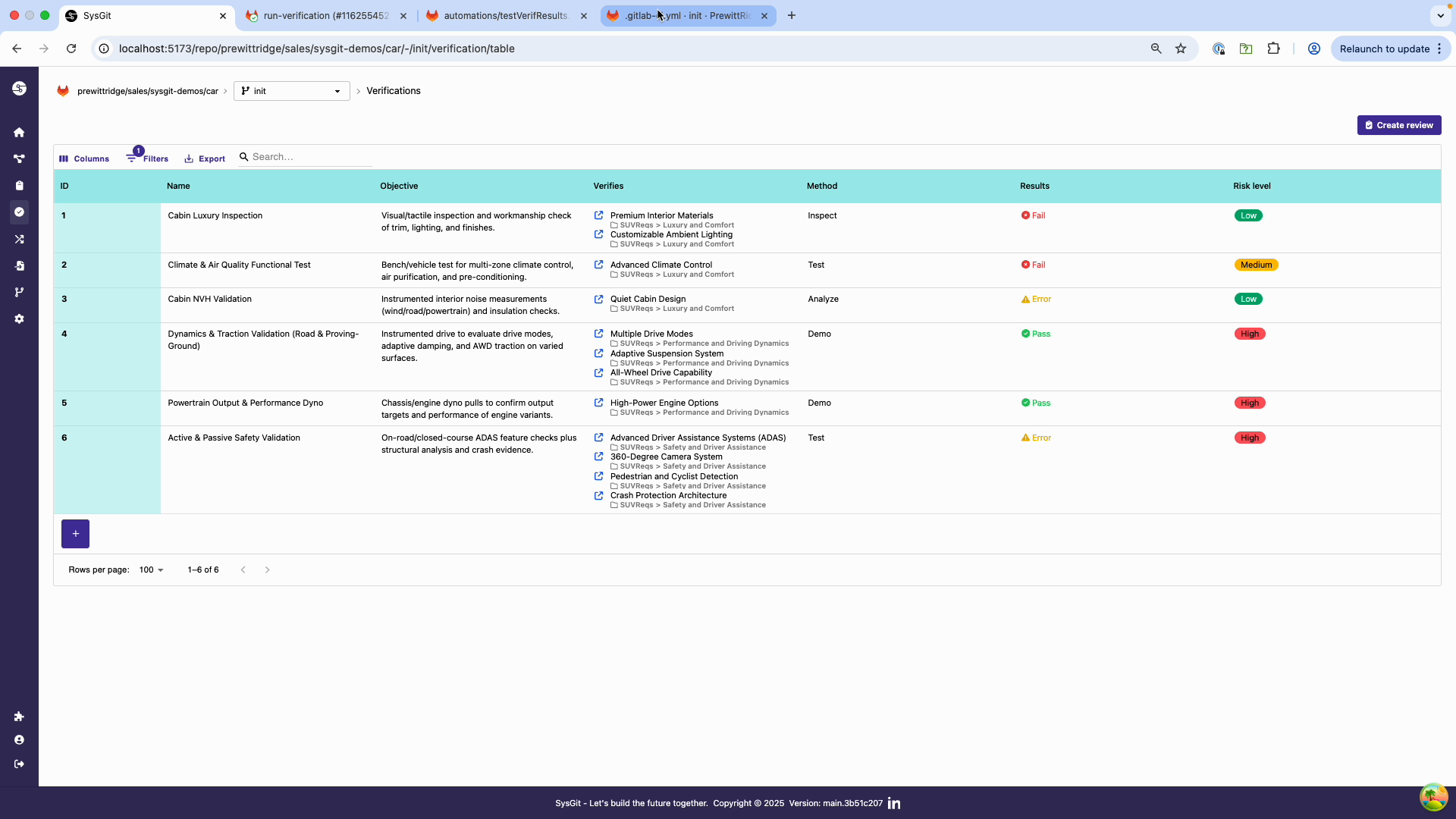 Verification verdicts automatically updated by CI/CD pipeline based on test execution
Linking to Test Systems#
Test Automation Frameworks#
SysGit can integrate with any test framework that produces machine-readable results. Common integration patterns include:
Python Test Frameworks#
For pytest, unittest, or custom Python test frameworks:
import sysgit as sg
import json

# Load test results from pytest JSON report
with open('test_results.json', 'r') as f:
    test_results = json.load(f)

# Load SysML model
model = sg.read("requirements.sysml")
verifications = model.select(sg.VerificationCaseUsage)

# Map test results to verifications
for v in verifications:
    test_name = v.qualified_name.split("::")[-1].strip("'")

    if test_name in test_results:
        result = test_results[test_name]
        if result['status'] == 'PASSED':
            v["verdict"].value = "VerdictKind::pass"
        elif result['status'] == 'FAILED':
            v["verdict"].value = "VerdictKind::fail"
        else:
            v["verdict"].value = "VerdictKind::error"

# Write updated model
model.write("requirements.sysml", overwrite=True)
Hardware-in-the-Loop (HIL) Systems#
For HIL test systems that output structured data:
import sysgit as sg
import csv

# Read HIL test results from CSV
hil_results = {}
with open('hil_results.csv', 'r') as f:
    reader = csv.DictReader(f)
    for row in reader:
        hil_results[row['test_case']] = {
            'verdict': row['pass_fail'],
            'timestamp': row['timestamp'],
            'details': row['notes']
        }

# Update verifications
model = sg.read("requirements.sysml")
verifications = model.select(sg.VerificationCaseUsage)

for v in verifications:
    name = v.qualified_name.split("::")[-1].strip("'")
    if name in hil_results:
        verdict_map = {
            'PASS': 'VerdictKind::pass',
            'FAIL': 'VerdictKind::fail',
            'INCONCLUSIVE': 'VerdictKind::inconclusive'
        }
        v["verdict"].value = verdict_map[hil_results[name]['verdict']]

model.write("requirements.sysml", overwrite=True)
Software Test Automation#
Integration with test management systems like TestRail or Jama Connect:
import sysgit as sg
import requests

# Fetch test results from TestRail API
response = requests.get(
    'https://your-instance.testrail.com/api/v2/get_results_for_run/123',
    auth=('username', 'api_key')
)
test_results = response.json()

# Update SysGit model
model = sg.read("requirements.sysml")
verifications = model.select(sg.VerificationCaseUsage)

# Map TestRail results to SysGit verdicts
status_map = {
    1: 'VerdictKind::pass',      # Passed
    5: 'VerdictKind::fail',      # Failed
    2: 'VerdictKind::inconclusive',  # Blocked
    4: 'VerdictKind::inconclusive'   # Retest
}

for v in verifications:
    # Match by test case ID stored in verification metadata
    if hasattr(v, 'metadata') and 'testrail_case_id' in v.metadata:
        case_id = v.metadata['testrail_case_id']
        for result in test_results:
            if result['case_id'] == case_id:
                v["verdict"].value = status_map[result['status_id']]

model.write("requirements.sysml", overwrite=True)
Results Ingestion#
SysGit can ingest test results from various formats:
JSON Results#
import sysgit as sg
import json

def load_json_results(results_file):
    """Load test results from JSON file."""
    with open(results_file, 'r') as f:
        return json.load(f)

def map_verdict(status):
    """Map test status to SysML VerdictKind."""
    mapping = {
        'PASSED': 'VerdictKind::pass',
        'FAILED': 'VerdictKind::fail',
        'ERROR': 'VerdictKind::error',
        'SKIPPED': 'VerdictKind::inconclusive',
    }
    return mapping.get(status, 'VerdictKind::inconclusive')

# Main ingestion logic
model = sg.read("requirements.sysml")
results = load_json_results("test_results.json")

verifications = model.select(sg.VerificationCaseUsage)
for v in verifications:
    name = v.qualified_name.split("::")[-1].strip("'")
    if name in results:
        v["verdict"].value = map_verdict(results[name]['status'])

model.write("requirements.sysml", overwrite=True)
XML Results (JUnit format)#
import sysgit as sg
import xml.etree.ElementTree as ET

def parse_junit_xml(xml_file):
    """Parse JUnit XML test results."""
    tree = ET.parse(xml_file)
    root = tree.getroot()

    results = {}
    for testcase in root.findall('.//testcase'):
        name = testcase.get('name')
        classname = testcase.get('classname')

        if testcase.find('failure') is not None:
            results[name] = 'VerdictKind::fail'
        elif testcase.find('error') is not None:
            results[name] = 'VerdictKind::error'
        elif testcase.find('skipped') is not None:
            results[name] = 'VerdictKind::inconclusive'
        else:
            results[name] = 'VerdictKind::pass'

    return results

# Update model with JUnit results
model = sg.read("requirements.sysml")
results = parse_junit_xml("junit_results.xml")

verifications = model.select(sg.VerificationCaseUsage)
for v in verifications:
    name = v.qualified_name.split("::")[-1].strip("'")
    if name in results:
        v["verdict"].value = results[name]

model.write("requirements.sysml", overwrite=True)
CSV Results#
import sysgit as sg
import csv

def load_csv_results(csv_file):
    """Load test results from CSV."""
    results = {}
    with open(csv_file, 'r') as f:
        reader = csv.DictReader(f)
        for row in reader:
            results[row['test_name']] = {
                'status': row['status'],
                'timestamp': row['timestamp'],
                'duration': row['duration']
            }
    return results

# Update model
model = sg.read("requirements.sysml")
results = load_csv_results("test_results.csv")

verdict_map = {
    'pass': 'VerdictKind::pass',
    'fail': 'VerdictKind::fail',
    'error': 'VerdictKind::error'
}

verifications = model.select(sg.VerificationCaseUsage)
for v in verifications:
    name = v.qualified_name.split("::")[-1].strip("'")
    if name in results:
        status = results[name]['status'].lower()
        v["verdict"].value = verdict_map.get(status, 'VerdictKind::inconclusive')

model.write("requirements.sysml", overwrite=True)
Status Updates#
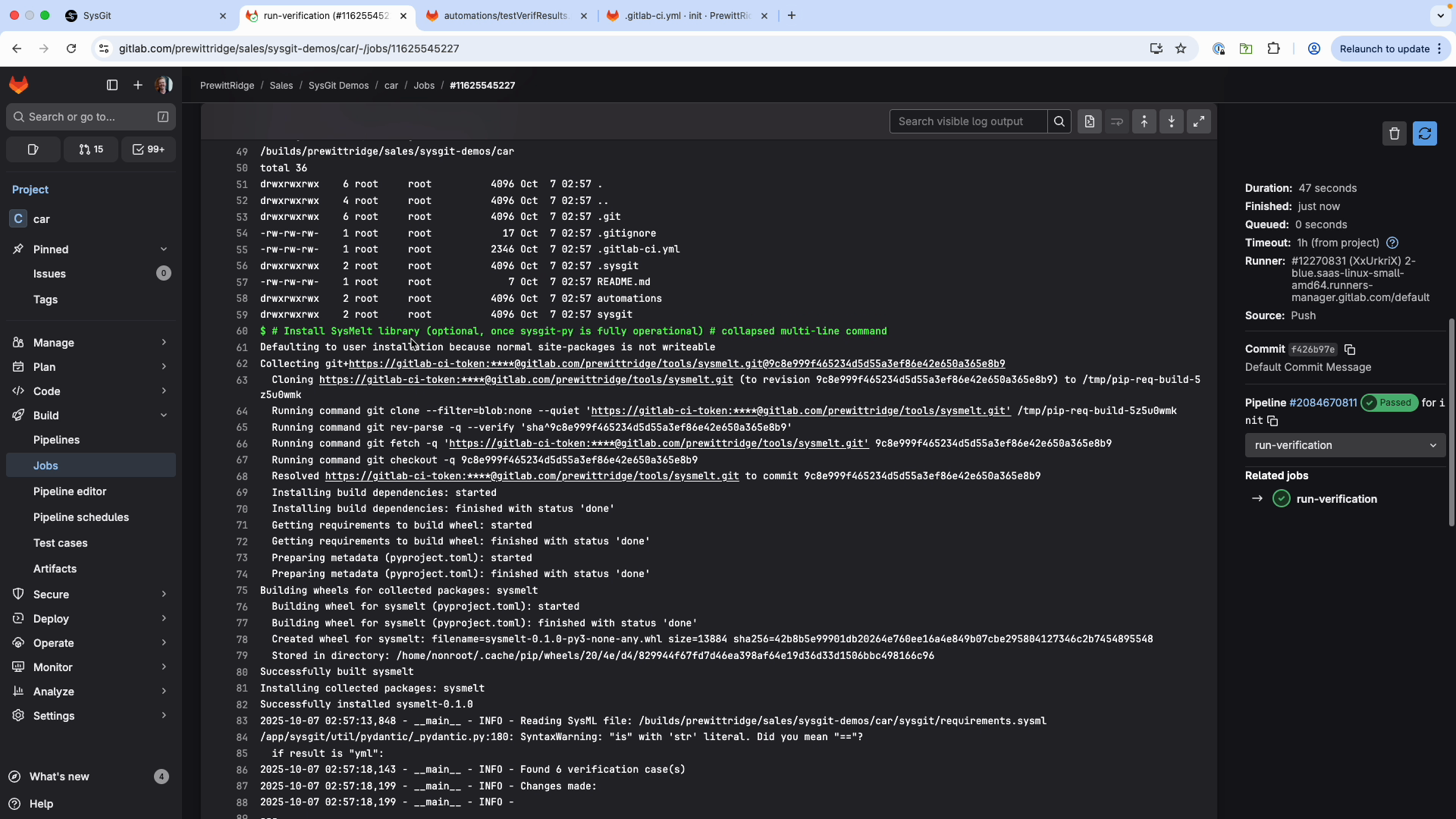 GitLab pipeline showing automated verification status updates
Real-Time Updates via CI/CD#
Configure GitLab CI/CD to run verification updates on every test execution:
stages:
  - test
  - update-verifications

run-tests:
  stage: test
  script:
    - pytest tests/ --junit-xml=test_results.xml
  artifacts:
    paths:
      - test_results.xml

update-verifications:
  stage: update-verifications
  needs: [run-tests]
  image: registry.gitlab.com/prewittridge/tools/sysgit-py/sysgit-py:0.1.5-amd64
  script:
    - python3 automations/ingest_test_results.py test_results.xml
    - |
      git config user.name "GitLab Runner"
      git config user.email "noreply@gitlab.com"
      git add sysgit/requirements.sysml
      git commit -m "chore: auto-update verification results [skip ci]"
      git push origin HEAD:${CI_COMMIT_REF_NAME}
Batch Updates#
For batch processing of historical test results:
import sysgit as sg
import glob
import json

model = sg.read("requirements.sysml")
verifications = model.select(sg.VerificationCaseUsage)

# Process all test result files
all_results = {}
for results_file in glob.glob("test_results/*.json"):
    with open(results_file, 'r') as f:
        results = json.load(f)
        all_results.update(results)

# Update verifications
for v in verifications:
    name = v.qualified_name.split("::")[-1].strip("'")
    if name in all_results:
        v["verdict"].value = all_results[name]['verdict']

model.write("requirements.sysml", overwrite=True)
print(f"Updated {len(verifications)} verifications from {len(all_results)} test results")
Simulation Integration#
Connecting to Analysis Tools#
SysGit can integrate with simulation and analysis tools to automatically update verification status based on simulation results.
MATLAB/Simulink Integration#
import sysgit as sg
import scipy.io

# Load MATLAB simulation results
mat_data = scipy.io.loadmat('simulation_results.mat')
sim_results = mat_data['results'][0]

model = sg.read("requirements.sysml")
verifications = model.select(sg.VerificationCaseUsage)

# Evaluate simulation results against requirements
for v in verifications:
    # Extract verification criteria from model
    # (implementation depends on your model structure)

    # Evaluate simulation data
    if evaluate_criteria(sim_results, v):
        v["verdict"].value = "VerdictKind::pass"
    else:
        v["verdict"].value = "VerdictKind::fail"

model.write("requirements.sysml", overwrite=True)
CAE/FEA Tool Integration#
For finite element analysis or computational fluid dynamics results:
import sysgit as sg
import numpy as np

def load_fea_results(results_file):
    """Load FEA results (e.g., from Nastran, ANSYS)."""
    # Parse results file (format depends on tool)
    return {
        'max_stress': 450.0,  # MPa
        'max_displacement': 2.3,  # mm
        'safety_factor': 1.8
    }

# Update structural verification cases
model = sg.read("requirements.sysml")
verifications = model.select(sg.VerificationCaseUsage)

fea_results = load_fea_results("structural_analysis.rst")

for v in verifications:
    name = v.qualified_name.split("::")[-1].strip("'")

    if 'Structural' in name:
        # Check against stress limits
        if fea_results['max_stress'] < 500.0:  # Allowable stress
            v["verdict"].value = "VerdictKind::pass"
        else:
            v["verdict"].value = "VerdictKind::fail"

model.write("requirements.sysml", overwrite=True)
Model-Based Systems Engineering (MBSE) Tool Integration#
Integration with tools like Cameo Systems Modeler or MagicDraw:
import sysgit as sg
import json

# Export simulation results from Cameo/MagicDraw
# (typically via custom plugins or APIs)

def load_mbse_simulation(results_file):
    """Load parametric simulation results from MBSE tool."""
    with open(results_file, 'r') as f:
        return json.load(f)

model = sg.read("requirements.sysml")
verifications = model.select(sg.VerificationCaseUsage)

sim_results = load_mbse_simulation("parametric_sim.json")

for v in verifications:
    # Match verification to simulation by name or ID
    # Evaluate simulation results against verification criteria
    # Update verdict accordingly
    pass

model.write("requirements.sysml", overwrite=True)
Verification via Simulation#
Trade Study Analysis#
Automatically verify requirements based on trade study results:
import sysgit as sg
import pandas as pd

# Load trade study results
trade_data = pd.read_csv('trade_study_results.csv')

model = sg.read("requirements.sysml")
verifications = model.select(sg.VerificationCaseUsage)

for v in verifications:
    name = v.qualified_name.split("::")[-1].strip("'")

    # Find corresponding trade study
    if name in trade_data['verification_name'].values:
        row = trade_data[trade_data['verification_name'] == name].iloc[0]

        # Check if selected design meets requirements
        if row['meets_requirement']:
            v["verdict"].value = "VerdictKind::pass"
        else:
            v["verdict"].value = "VerdictKind::fail"

model.write("requirements.sysml", overwrite=True)
Monte Carlo Analysis#
Update verification status based on probabilistic analysis:
import sysgit as sg
import numpy as np

def monte_carlo_analysis(requirement_spec, num_iterations=10000):
    """Run Monte Carlo simulation to verify requirement."""
    # Simulate with uncertainty distributions
    results = []
    for _ in range(num_iterations):
        # Your simulation logic here
        result = np.random.normal(100, 10)  # Example
        results.append(result)

    # Calculate probability of meeting requirement
    prob_success = np.mean(np.array(results) >= requirement_spec)
    return prob_success

model = sg.read("requirements.sysml")
verifications = model.select(sg.VerificationCaseUsage)

for v in verifications:
    # Extract requirement specification
    # Run Monte Carlo analysis
    prob = monte_carlo_analysis(requirement_spec=95.0)

    # Update verdict based on confidence level
    if prob >= 0.95:  # 95% confidence
        v["verdict"].value = "VerdictKind::pass"
    elif prob >= 0.50:
        v["verdict"].value = "VerdictKind::inconclusive"
    else:
        v["verdict"].value = "VerdictKind::fail"

model.write("requirements.sysml", overwrite=True)
Complete Example: Test System Integration#
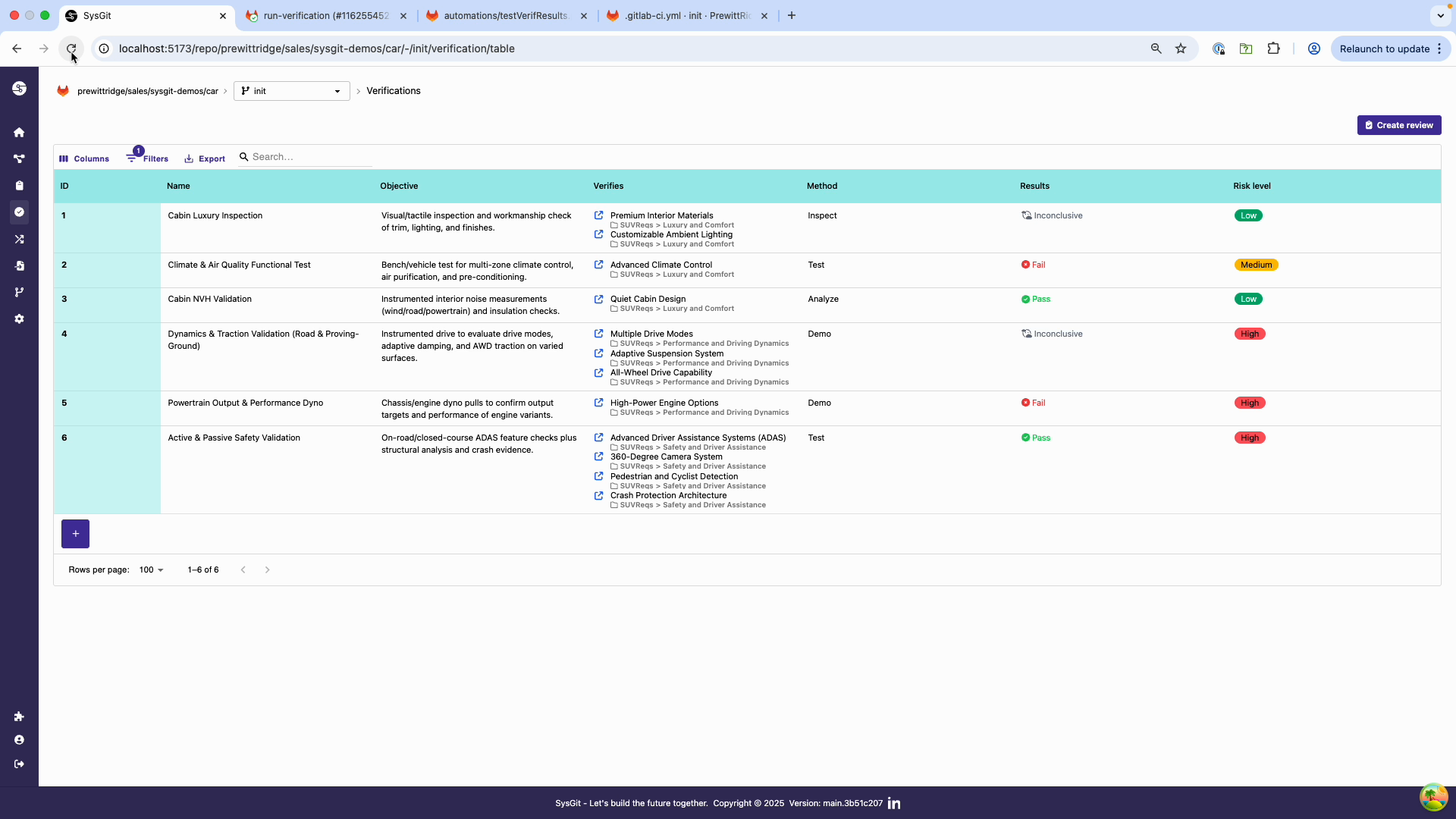 Verification table before automated updates from test execution
Here's a complete example showing end-to-end integration with a test system:
import sysgit as sg
import json
import logging
import argparse
import sys

# Set up logging
logging.basicConfig(level=logging.INFO)
logger = logging.getLogger(__name__)

def parse_args():
    """Parse command line arguments."""
    parser = argparse.ArgumentParser(
        description='Update verification verdicts from test results.'
    )
    parser.add_argument('sysml_file', help='Path to SysML file')
    parser.add_argument('test_results', help='Path to test results JSON')
    parser.add_argument('-o', '--output', help='Output file path')
    return parser.parse_args()

def load_test_results(results_file):
    """Load test results from JSON file."""
    with open(results_file, 'r') as f:
        return json.load(f)

def map_verdict(test_status):
    """Map test status to SysML VerdictKind."""
    mapping = {
        'PASSED': 'VerdictKind::pass',
        'FAILED': 'VerdictKind::fail',
        'ERROR': 'VerdictKind::error',
        'SKIPPED': 'VerdictKind::inconclusive',
    }
    return mapping.get(test_status, 'VerdictKind::inconclusive')

def update_verifications(model, test_results):
    """Update verification verdicts based on test results."""
    verifications = model.select(sg.VerificationCaseUsage)
    updated_count = 0

    for v in verifications:
        # Extract verification name
        name = v.qualified_name.split("::")[-1].strip("'")

        # Check if test result exists
        if name in test_results:
            test_result = test_results[name]
            verdict = map_verdict(test_result['status'])
            v["verdict"].value = verdict

            logger.info(f"Updated '{name}': {test_result['status']} -> {verdict}")
            updated_count += 1
        else:
            logger.warning(f"No test result found for: {name}")

    return updated_count

def main():
    args = parse_args()

    try:
        # Load model
        logger.info(f"Reading SysML file: {args.sysml_file}")
        model = sg.read(args.sysml_file)

        # Load test results
        logger.info(f"Loading test results: {args.test_results}")
        test_results = load_test_results(args.test_results)

        # Update verifications
        updated = update_verifications(model, test_results)
        logger.info(f"Updated {updated} verification(s)")

        # Save model
        output_file = args.output if args.output else args.sysml_file
        logger.info(f"Writing updated model: {output_file}")
        model.write(output_file, overwrite=True)

        logger.info("Done!")
        return 0

    except Exception as e:
        logger.error(f"Error: {e}")
        return 1

if __name__ == "__main__":
    sys.exit(main())
Usage in GitLab CI/CD:
update-verifications:
  stage: update-verifications
  needs: [run-tests]
  script:
    - python3 automations/update_from_tests.py \
        sysgit/requirements.sysml \
        test_results.json
Best Practices#
Naming Conventions#
Maintain consistent naming between test cases and verification cases:
# Good: Direct name mapping
test_name = "Cabin_Luxury_Inspection"
verification_name = "Cabin Luxury Inspection"

# Use standardized formatting function
def normalize_name(name):
    """Convert between test and verification naming."""
    return name.replace('_', ' ').title()
Error Handling#
Always validate test results before updating model:
def validate_test_results(results):
    """Ensure test results have required fields."""
    required_fields = ['test_name', 'status', 'timestamp']

    for test_name, test_data in results.items():
        for field in required_fields:
            if field not in test_data:
                raise ValueError(f"Missing field '{field}' in test '{test_name}'")

    return True
Audit Trail#
Log all updates for compliance and debugging:
import logging
from datetime import datetime

# Create detailed audit log
audit_log = []

for v in verifications:
    old_verdict = v["verdict"].value
    new_verdict = map_verdict(test_results[name]['status'])

    if old_verdict != new_verdict:
        audit_log.append({
            'timestamp': datetime.now().isoformat(),
            'verification': name,
            'old_verdict': old_verdict,
            'new_verdict': new_verdict,
            'test_id': test_results[name]['test_id']
        })
        v["verdict"].value = new_verdict

# Save audit log
with open('verification_updates.log', 'a') as f:
    json.dump(audit_log, f, indent=2)
Handling Partial Results#
Gracefully handle incomplete test data:
def update_with_partial_results(model, test_results):
    """Update only verifications with available test results."""
    verifications = model.select(sg.VerificationCaseUsage)

    updated = []
    skipped = []

    for v in verifications:
        name = v.qualified_name.split("::")[-1].strip("'")

        if name in test_results:
            v["verdict"].value = map_verdict(test_results[name]['status'])
            updated.append(name)
        else:
            skipped.append(name)

    logger.info(f"Updated: {len(updated)}, Skipped: {len(skipped)}")
    return updated, skipped
See Also#
- CI/CD Overview - General CI/CD concepts and architecture
- Custom Automation - Building custom automation scripts
- Verification Management - Manual verification workflows